























How Does Home Court Advantage Affect Basketball Performance?
Research-based analysis of home court advantage in basketball — NBA home win rates, crowd effects, referee influence, the declining trend and strategic implications.

Basketball, played in enclosed arenas with passionate crowds and minimal travel variability between venues, has long been one of the clearest laboratories for studying home court advantage. Decades of NBA and collegiate data confirm that home teams win more often, score more, and benefit from a measurable point spread — yet the phenomenon has been shrinking, sparking debate about its causes and future. From the roaring Jazz home crowds of the 1990s to the bubble environments of 2020, basketball offers rich evidence on how venue affects performance.
1. The Numbers: Measuring Home Court Advantage
Home court advantage in basketball is typically quantified in three ways:
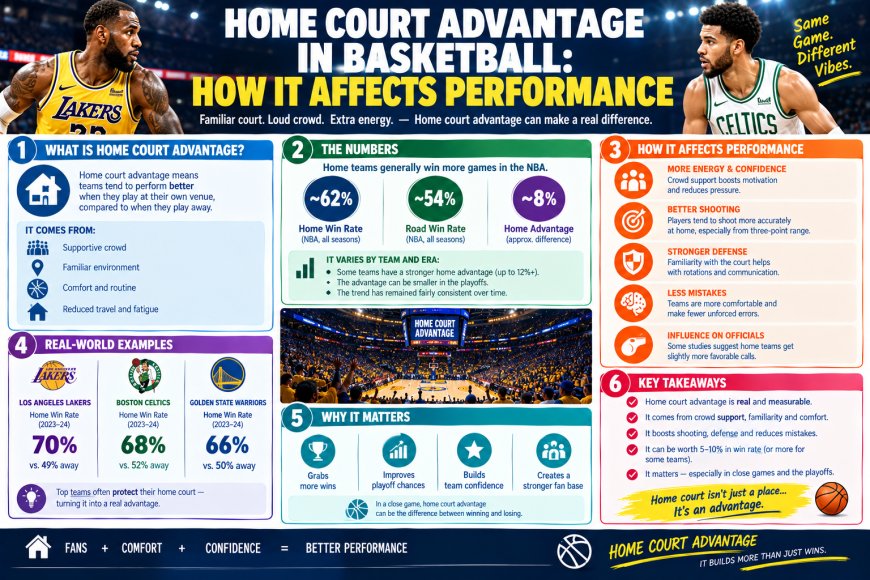
· Home win percentage: NBA home teams have historically won between 55% and 68% of games depending on the era — comfortably above the 50% neutral expectation.
· Average home margin: The typical scoring advantage for home teams. Historical analysis spanning 43 years of NBA data shows eras ranging from roughly +4.9 points per game in the Bird/Magic/Jordan ascendancy era (1983–92) down to approximately +1.8 points in the modern post-COVID period (2020–26) — a substantial decline.
· Win rate by era: The same analysis tracked home win rates falling from about 65.8% in the 1980s to around 55.1% in recent seasons — the advantage persisting but markedly reduced.
Research cited in academic work also notes that home teams score roughly 3.24 more points than visitors in some studied periods (Entine & Small, 2007), while classic sports-psychology reviews place basketball's home win rates among the highest of major team sports alongside soccer.
The COVID-19 "bubble" and empty-arena experiments were pivotal: studies found home teams won by approximately 2.2 additional home games per season with fans present versus absent — and estimated that each additional thousand fans adds measurable margin. The mere presence of home fans, the research concluded, explains a larger share of home court advantage than previously assumed.
Even at reduced levels, a 2–3 point home margin matters enormously in a sport where many games finish within one possession: sportsbook lines routinely price NBA home court at 2.5–3.5 points, acknowledging its persistent, if diminished, reality.
2. Why Does Home Court Advantage Exist in Basketball?
Basketball's home advantage draws on the same core mechanisms as other sports — crowd, travel, familiarity, officiating — with sport-specific twists.
Crowd Noise and Psychological Energy
Arena crowds are closer to the court in basketball than in almost any major sport — fans sit meters from the action, and decibel levels during opponent free throws or home runs of momentum are extreme. Research consistently links crowd size and noise to performance benefits: arousal elevates home players' effort and aggressiveness, while opponents experience communication difficulties (calling out switches, screens, and coverages becomes harder) and elevated anxiety.
Free throws illustrate the effect microscopically: multiple studies have examined whether crowd noise affects shooter concentration — with mixed but suggestive findings showing small degradation for visiting shooters in hostile environments, particularly in clutch situations.
Travel and Routine
NBA travel is substantial — cross-country flights, time-zone shifts, and compressed road schedules disrupt sleep, nutrition, and practice routines. Home teams sleep in their beds and maintain normal routines. Sports-science research on travel fatigue finds measurable effects on reaction time and sprint recovery — factors directly relevant to a sport of repeated high-intensity efforts. The effect compounds during road trips: performance often dips further as trips lengthen, a pattern teams track carefully.
Familiarity With Environment
Home teams practice on their own court daily: they know the rims' bounce, sightlines, background contrast behind baskets (shooting familiarity), locker-room routines, and arena acoustics. Visitors adapt during shootaround, but research on environmental familiarity suggests the advantage of chronic exposure persists — particularly for shooting, where visual-spatial calibration benefits from repetition in the same setting. Home-court advantage in basketball can involve crowd support, familiarity with the court, travel factors, and routine, all of which can form part of the match environment. Keep up with basketball and sports action on Mahadev Book.
Officiating
Do referees favor home teams in the NBA? This remains one of basketball's most contested questions. Analyses of play-by-play data and official "Last Two Minutes" reports (which review officiating in close late-game situations) have identified potential home-vs-away bias patterns — though the magnitude and even existence of significant bias are debated among researchers. Mechanisms proposed include crowd pressure on judgment calls (block/charge, shooting fouls) and the sheer difficulty of officiating in hostile noise.
Even researchers skeptical of large referee effects acknowledge that perceptions of bias influence team behavior — home teams attack the rim more aggressively expecting favorable whistles, visitors may avoid contact, creating self-fulfilling behavioral differences.
Strategic and Psychological Factors
Home coaches may take more calculated risks (early timeouts, unusual rotations) backed by crowd energy; home players show higher average aggressiveness in tracking data in some studies. Conversely, visiting teams sometimes adopt conservative game plans — pacing, protecting against runs — that can cede initiative.
3. How the Advantage Manifests in Game Data
Basketball's box score and tracking data reveal where home advantage shows up:
· Scoring margin: The most direct manifestation — historically concentrated in certain game phases. Interesting research finds home advantage in the NBA is strongly front-loaded — establishing early in games (first quarter margins historically larger) rather than purely accumulating late.
· Free throw attempts: Home teams have historically shot more free throws in some eras — a blend of aggressive rim attacks and potential officiating effects.
· Field goal percentage (especially 2-point): Familiar rims and confident shot selection can nudge home shooting efficiency modestly.
· Pace and style: Some analyses find home teams play slightly faster or with more possession in the frontcourt — dictated by comfort and crowd-driven tempo.
· Turnovers and communication errors: Visitors, hampered by noise, may commit slightly more live-ball turnovers — though effects vary by study.
· Fourth-quarter dynamics: Clutch shooting splits, late-game foul decisions, and timeout patterns shift under home crowd intensity.
Modern tracking adds finer lenses: speed, acceleration, and defensive contest rates by venue; lineup net ratings home vs. road; and shot-quality models comparing expected versus actual shooting by location.
4. The Declining Trend — and Explanations
Perhaps the most discussed modern finding is the erosion of NBA home court advantage. The multi-decade decline documented in era-by-era analyses (68% home wins → 55%; +4.9 → +1.8 margin) demands explanation. Proposed causes include:
1. The three-point revolution: One analysis found a striking negative correlation (r = −0.88) between league-wide three-point attempt rates and home win percentages — as 3PA soared from ~2.4 per game in 1983 to nearly 38 by 2025, home win rates fell. The mechanism proposed: three-point-heavy offenses reduce the value of familiar-court advantages in the mid-range game and compress variance — hot shooting nights neutralize crowd-fueled runs. Relatedly, declining free-throw rate gaps account for a meaningful share of the lost home scoring edge.
2. Improved travel and recovery science: Charter flights, sleep labs, and road-crew logistics have professionalized travel costs away.
3. Standardized arenas and preparation: Modern facilities, identical floors, and video scouting reduce environmental surprises.
4. Player empowerment and road resilience: Superstars are accustomed to hostile environments through international play and media saturation; the "intimidating fortress" narrative has weakened.
5. Empty-arena normalization: The 2020 experiments may have permanently altered some behavioral patterns around crowd reliance.
The decline is not uniform — certain franchises retain outsized home records (small-market intensity, unique altitude/geography factors like Denver's, or simply superior roster construction) — but the league-wide trend is clear: home court remains an edge, no longer a fortress.
5. Variation Across Teams, Contexts, and Levels
Home advantage is heterogeneous:
· Team-specific profiles: Teams with young rosters or heavy communication-dependent schemes may benefit more from quiet home environments; veteran road-tested squads show smaller home/away splits.
· Altitude and geography: The Denver Nuggets' altitude advantage (playing at 5,280 feet) is a famous physical differentiator — visiting teams face genuine oxygen-deprivation effects that research confirms impair repeated-sprint performance.
· Collegiate basketball: NCAA home advantage often exceeds NBA levels in passionate student environments — hostile arenas, unfamiliar shooting backgrounds, and student-section disruption of opponent free throws have measurable effects; some conferences show home win rates well above 70% historically.
· International and FIBA contexts: Neutral-site tournaments (Olympics, World Cups) eliminate traditional home advantage except for the designated host nation — which typically enjoys elevated support and familiar conditions.
6. Strategic Implications for Teams
Modern NBA organizations treat home court as a strategic asset to optimize:
· Schedule and rotation management: Coaches manage minutes and rest around road trips; star rest decisions cluster on road back-to-backs.
· Home identity amplification: Teams design aggressive early-game scripts to leverage crowd energy — the front-loaded advantage suggests seizing first-quarter momentum matters.
· Road preparation: Silence-the-crowd strategies (free-throw distraction tactics by opponents, fast starts to quiet arenas), standardized travel routines, and mental-performance coaching for hostile environments.
· Lineup research: Analytics staffs study which lineups hold up best on the road (switchable, low-communication-requiring units) versus home (aggressive, crowd-synergistic groups).
7. Implications for Analysis and Prediction
For analysts and forecasters:
· Price home court explicitly: Even at ~2–3 points, it remains a non-trivial input in NBA prediction models — smaller than in the 1980s, but far from zero.
· Split team ratings by venue: Home and away net ratings can reveal hidden context — a team dominant at home but poor on the road may have a specific structural vulnerability (transition defense that travels badly, for instance).
· Account for rest and travel chains: A home team on two days' rest versus a visiting team finishing a three-in-four road set skews the effective home margin beyond baseline.
· Beware double-counting: Crowd effects are partially embedded in historical home records — modern models that add both large home constants and team-quality estimates derived from same data can overstate the effect.
8. Open Questions and Future Directions
Research continues on several frontiers:
· Referee behavior under technology-review regimes and whether accountability reduces (or merely redistributes) home-bias perceptions.
· Crowd-density vs. crowd-noise experiments — isolating acoustic from visual intimidation.
· The three-point link: Is the correlation between 3PA growth and home-advantage decline causal or coincidental? Longitudinal work continues.
· International replication: Does the decline pattern hold across EuroLeague, NBL, and other professional leagues with different travel and crowd cultures?
What remains stable is the directional finding: home teams in basketball win more than half the time, by a margin that has narrowed but not vanished.
9. Home Court Advantage Beyond the NBA
The phenomenon extends well beyond the professional American game, and comparing contexts sharpens understanding:
· Women's basketball (WNBA and international): Similar home-advantage patterns appear, with crowd effects and travel burdens operating on the same principles — studies of international women's basketball find persistent home win-rate elevation across decades of data.
· European leagues (EuroLeague, domestic leagues): Fierce home crowds, varied travel distances, and distinctive arena cultures produce home margins comparable to or exceeding modern NBA levels in some seasons — Turkey, Greece, and Serbia's basketball cultures are frequently cited for intense home environments.
· College basketball (NCAA): As noted, student sections, unfamiliar shooting backgrounds in smaller gyms, and passionate regional followings often produce larger home effects than the professional game — the "home court" in college is genuinely feared.
· International competitions: Host nations in World Cups and Olympics enjoy documented home bumps — crowd support combined with no travel and familiar time zones — while neutral venues strip the effect entirely, giving analysts a clean baseline for comparison.
These parallels confirm that home advantage is not an NBA quirk but a structural feature of basketball wherever crowds, travel, and venue familiarity vary between competitors — with magnitude tuned by culture, competition design, and era.