






















Basketball Positions Explained: What Does Each Player Do On The Court?
Complete guide to basketball positions — point guard, shooting guard, small forward, power forward and center roles, modern evolution, skills and positionless basketball explained.

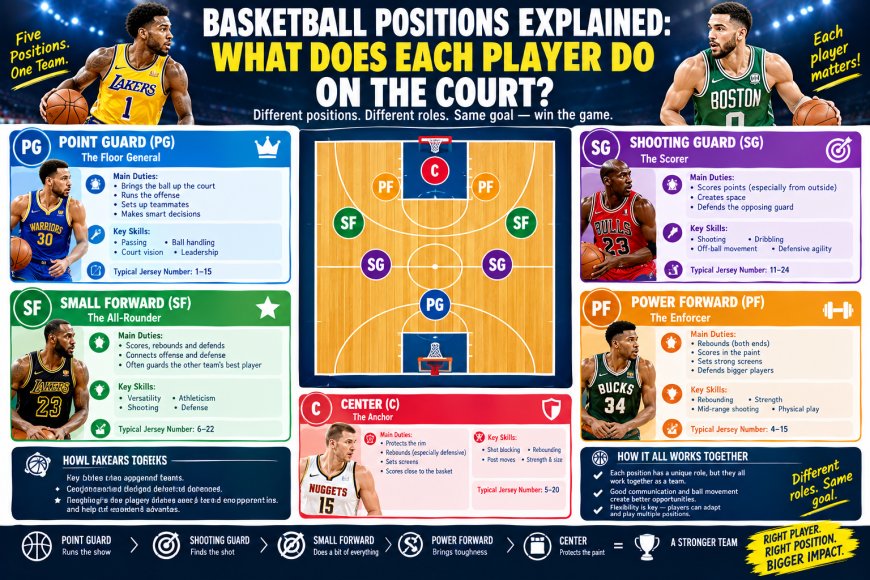
Basketball is often celebrated as a positionless game — and modern NBA lineups increasingly blur traditional roles. Yet beneath the flexibility lies a stable foundation: five distinct functional responsibilities that every team must cover. Understanding what each basketball position does — point guard, shooting guard, small forward, power forward, and center — remains essential for reading the game, evaluating players, and appreciating how tactical systems fit together. Even as labels evolve ("wing," "big," "combo guard"), the core jobs of initiating, scoring, spacing, rebounding, and protecting the rim persist.
1. The Traditional Framework: One Through Five
Basketball's numbering convention runs as follows:
1. Point Guard (PG) — the floor general
2. Shooting Guard (SG) — the backcourt scorer
3. Small Forward (SF) — the versatile wing
4. Power Forward (PF) — the hybrid big
5. Center (C) — the interior anchor
Offensive sets, defensive assignments, and substitution patterns have historically organized around these five slots. While today's "positionless" basketball often replaces the labels with functional descriptions (ball-handler, wing, big), the underlying distribution of responsibilities across five players remains — every team still needs someone to initiate offense, someone to rim protect, someone to space the floor, and so on.
2. Point Guard: The Orchestrator
Traditional Role
The point guard (often called the "1") is the primary ball-handler and playmaker — the quarterback of the offense. Classical duties include:
· Bringing the ball up against pressure and initiating sets.
· Running the coach's plays — calling formations, directing traffic, managing tempo.
· Distributing to scorers — finding cutters, feeding post players, kicking to shooters.
· Controlling game pace — slowing for a final shot, pushing in transition, managing leads.
· Defending the opposing floor general — usually the opponent's quickest decision-maker.
Hall-of-fame prototypes like Magic Johnson, John Stockton, and Jason Kidd embodied pure distribution: high assists, low turnovers, elite court vision.
Modern Evolution
Today's point guards are scorers as much as passers. The "combo guard" and "scoring point guard" archetypes — Stephen Curry, Luka Dončić, Damian Lillard, Shai Gilgeous-Alexander — blend deep three-point range with pick-and-roll mastery. Analytics validated what scouts long intuited: a point guard who cannot threaten scoring lets defenders go under screens and ignore him, breaking the offense. The modern 1 must force defensive decisions — shoot, drive, or pass — on every pick-and-roll.
Key skills: Ball-handling under pressure, pick-and-roll reading, court vision, pull-up shooting, pace management, and on-ball defense against elite handlers.
3. Shooting Guard: The Backcourt Scorer
Traditional Role
The shooting guard ("2") historically paired with the point guard as the backcourt's primary scorer — a player who moves without the ball, comes off screens, and converts at high rates from mid-range and beyond:
· Catch-and-shoot mastery — relocating to passing lanes and burying catch-and-shoot threes.
· Off-screen scoring — curling, flaring, and elevator-screen actions à la Reggie Miller or Ray Allen.
· Secondary creation — attacking closeouts when the primary play breaks down.
· Perimeter defense — often assigned to the opponent's best scoring guard.
Modern Evolution
The two-guard has absorbed more creation duties in modern systems — James Harden's move to primary initiator, Devin Booker's hybrid orchestration role, and Klay Thompson's pure-stationary-sniper model represent different evolutionary paths. The analytics era elevated the "3-and-D wing," sometimes shrinking traditional SG duties into specialist shooting roles — while others expanded into full offensive engines.
Key skills: Movement shooting, free-throw drawing, off-ball conditioning, lateral quickness for point-of-attack defense, and increasingly, secondary playmaking.
4. Small Forward: The Swiss Army Knife
Traditional Role
The small forward ("3") occupies basketball's most physically diverse role — typically the player with the ideal blend of size, speed, and skill:
· Wing scoring — attacking off the dribble, cutting, and hitting open threes.
· Defensive versatility — capable of guarding positions 2 through 4 in switching schemes.
· Transition running — filling lanes in the open court with finishing ability.
· Secondary ball-handling — bringing the ball up when the point guard rests.
Julius Erving, Larry Bird, and LeBron James represent the position's superstar ceiling: players who can legitimately run offense while defending multiple positions.
Modern Evolution
In the three-point era, the small forward has become the NBA's most coveted archetype — the "3-and-D wing" who spaces the floor and absorbs the toughest perimeter assignment. Championship rosters reliably feature switchable wings who can punish mismatches on offense and neutralize stars on defense (Kawhi Leonard's two-way peaks, Paul George, Jayson Tatum, Jimmy Butler). The rise of "point-forward" playmaking — initiators at forward size — has further expanded the role beyond classical scoring.
Key skills: Pull-up shooting, wing defense, transition finishing, screening/cutting intelligence, and the strength to attack closeouts.
5. Power Forward: The Hybrid Big
Traditional Role
The power forward ("4") was classically the "tough guy" frontcourt partner to the center — rebounding, screening, scoring in the paint:
· Interior physicality — banging in the post, boxing out, offensive rebounding.
· Mid-range scoring — the classic face-up and back-to-the-basket game.
· Pick-and-roll/pick-and-pop partnership — setting screens for guards and diving or popping.
· Help-side shot blocking — weak-side rim protection behind the center.
Legends like Karl Malone, Charles Barkley, and Tim Duncan defined different flavors — power, rebounding fury, and fundamentally complete two-way play.
Modern Evolution
No position has changed more. The "stretch four" — a power forward who shoots threes — became a roster-building cornerstone after analytics established spacing value. Today's elite power forwards (Giannis Antetokounmpo as a point-center-wing hybrid, Kevin Durant's scoring-forward model, Draymond Green's playmaking defensive hub) often blur into small-ball centers or oversized wings. Defensively, many modern 4s switch onto guards — requiring lateral agility unthinkable for the position's 1980s prototype. Basketball positions have different responsibilities, with players contributing through playmaking, scoring, rebounding, defense, and creating opportunities for teammates. Explore basketball and sports updates with Mahadev Book.
Key skills: Corner and top-of-key three-point shooting, short-roll playmaking, switchable defense, screen setting, and rebounding against bigger lineups.
6. Center: The Interior Anchor
Traditional Role
The center ("5") traditionally anchored both ends of the court — the tallest player, positioned nearest the basket:
· Rim protection — the last line of defense, blocking and altering shots.
· Rebounding dominance — defensive boards to end possessions, offensive boards for second chances.
· Low-post scoring — deep position moves, drop steps, hooks (the classic center basket).
· Screening hub — setting the ball screens that drive pick-and-roll offenses.
· Tip-offs and interior passing — high post playmaking in motion offenses.
Bill Russell, Wilt Chamberlain, Hakeem Olajuwon, and Shaquille O'Neal represent the position's historically overwhelming interior influence.
Modern Evolution
The center position has bifurcated. Traditional rim-running centers (Rudy Gobert, Mitchell Robinson) protect the paint and finish lobs while sacrificing shooting. Stretch and playmaking centers (Nikola Jokić's MVP playmaking, Joel Embiid's face-up scoring, Karl-Anthony Towns' three-point range) drag opposing bigs away from the rim or run offense through the high post. The "small-ball five" — a power forward or wing playing center in crunch time — has become a common closing lineup, prioritizing switching and shooting over height.
Jokić's evolution deserves special note: a center leading league assists reframed what the position can do — proving the 5 can be an offense's primary engine rather than its finishing accessory.
Key skills: Rim protection timing, screen angles, catch-and-finish efficiency, post footwork (if used), defensive rebounding, and increasingly, passing and corner-three shooting.
7. How the Five Positions Work Together
Team strategy is the art of combining these roles:
· Pick-and-roll duos: The most common action pairs a guard (1 or 2) with a big (4 or 5) — spacing shooters (2/3/4) around them.
· Inside-out balance: A rim-protecting center enables aggressive perimeter pressure; shooting around that center punishes help defense.
· Wing-centric systems: Modern "five-out" offenses treat all positions as shooters/playmakers — spacing substitutes for traditional post play.
· Defensive scheme fit: Switch-heavy defenses require five mobile defenders; drop-coverage defenses need a paint-protective anchor.
· Rebounding distribution: Guards who rebound spark transition; bigs who rebound end possessions — teams balance crash vs. retreat strategies accordingly.
Championship teams typically answer three questions affirmatively: Who creates? Who protects the rim? Who spaces the floor? — with players who cover multiple answers holding the highest value.
8. Positionless Basketball: The Modern Reality
The NBA's trend toward positionless play doesn't eliminate functions — it multiplies their carriers:
· "Positionless" doesn't mean "roleless": Someone still initiates; someone still rebounds; someone still finishes. The difference is that taller players handle and shorter players protect — skills distributed unconventionally.
· Lineup construction over labels: Coaches describe lineups by archetype ("switch-everything," "two-big," "small-ball") rather than 1-through-5 labels.
· Positional versatility premium: Players who can defend 3–4 positions and shoot (the ultimate switchable wing) command the highest trade value in the league.
· Fantasy and media persistence: Despite evolution, the five-position framework endures in box scores, fantasy basketball, and broadcast commentary — making literacy in both traditional and modern frameworks essential.
9. Youth and Developmental Perspective
For developing players and coaches, position fundamentals still matter:
· Young bigs learn guard skills early now — handling and shooting projected forward prevent obsolescence later.
· Guards learn post defense and rebounding — modern switching demands it.
· Balanced development beats premature specialization in most youth programs — the players who reach elite levels typically own a primary position identity plus secondary competencies.
Understanding the traditional duties gives learners a map; understanding the modern flexibilities shows them where the map's borders are dissolving.
10. Quick Reference: Position Comparison
|
Position |
Primary Job |
Key Skill |
Modern Watchword |
|
Point Guard (1) |
Initiate & create |
Pick-and-roll mastery |
Scoring passers |
|
Shooting Guard (2) |
Backcourt scoring |
Movement shooting |
Combo creation |
|
Small Forward (3) |
Two-way versatility |
Switch defense + shooting |
3-and-D wing |
|
Power Forward (4) |
Hybrid frontcourt |
Stretch shooting / switching |
Positionless big |
|
Center (5) |
Rim protect & rebound |
Paint dominance |
Playmaking/stretch 5 |
10. Common Position Questions Answered
A few questions frequently asked by newer fans, addressed directly:
· Can a point guard play shooting guard? Often yes — many combo guards slide between the 1 and 2 depending on lineup needs, though defensive assignments and initiation duties shift accordingly.
· What is a "wing"? A collective term for the 2, 3, and sometimes 4 — players who operate on the perimeter's flanks. "Wing depth" describes roster strength at these spots.
· What does "big" mean? Usually the 4 and 5 — the frontcourt players closest to the basket, regardless of exact positional labels.
· Is there a "most important" position? Construct-dependent: contenders typically need a creator (often a guard or playmaking forward), a rim protector, and shooting — multiple positions can supply each. Championship pedigrees historically correlate most with elite top-end talent at any position rather than one slot dominating.
· What is a "point forward"? A forward who initiates offense like a point guard — LeBron James, Luka Dončić (guard/forward hybrid), and Ben Simmons in his prime exemplified the type, collapsing traditional role boundaries.
These vocabulary tools let fans read lineups, broadcasts, and analytics discussions with confidence — the bridge between learning positions and understanding modern basketball language.