























EB1A Eligibility in 2025: What You Must Know Before You Apply

Applying for a U.S. green card under the EB1A (Employment-Based First Preference) category is a dream for many high-achieving professionals. In 2025, this visa pathway continues to be a prestigious option for individuals with extraordinary abilities in fields such as science, education, business, athletics, or the arts. However, navigating the eligibility requirements can be challenging without a clear understanding of what qualifies as "extraordinary."
What Is the EB1A Visa and Why Is It So Desirable?
The EB1A visa stands out because it allows individuals to self-petitionmeaning no U.S. employer sponsorship is required. Moreover, it generally offers faster processing times compared to other employment-based green cards. If approved, you gain lawful permanent residency in the U.S., along with the ability to live and work freely.
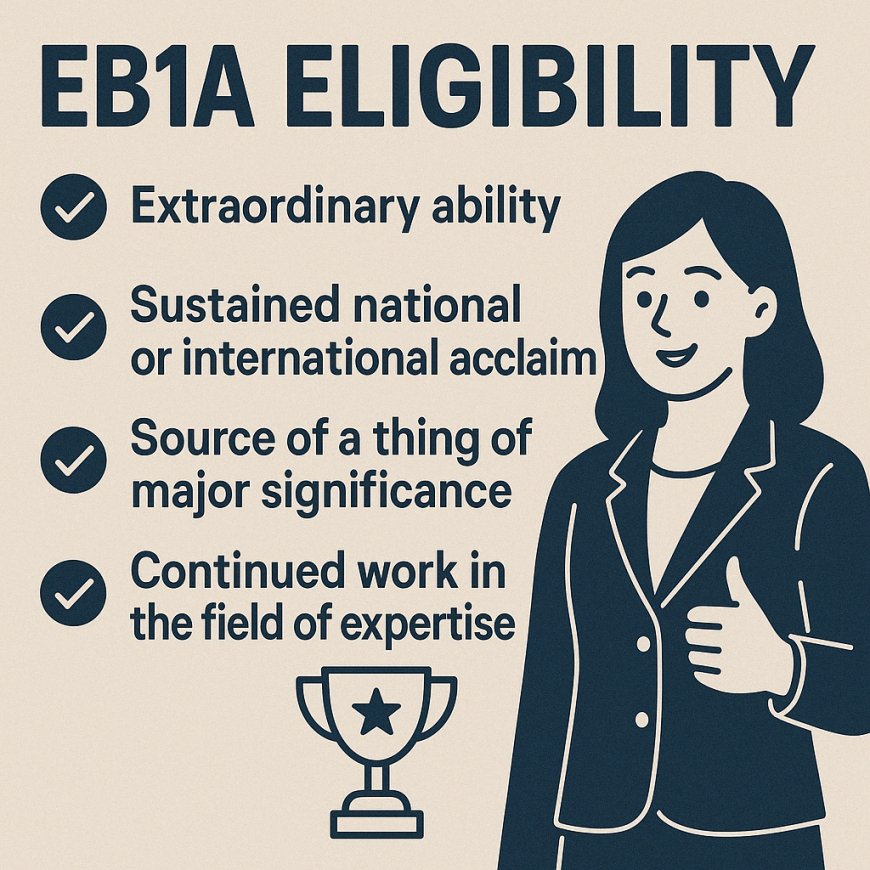
The key requirement? Demonstrating extraordinary ability in your professional field, recognized through sustained national or international acclaim.
Updated EB1A Eligibility Requirements in 2025
The foundation of EB1A Eligibility remains consistent, but interpretations of qualifying evidence have become more refined in 2025. To qualify, you must either have a major internationally recognized award (like a Nobel Prize), or fulfill at least 3 out of 10 specified criteria set by the United States Citizenship and Immigration Services (USCIS).
These criteria include:
-
Receipt of lesser nationally or internationally recognized prizes or awards.
-
Membership in associations that require outstanding achievements.
-
Published material about you in major trade or professional publications.
-
Participation as a judge of the work of others.
-
Original scientific, scholarly, or artistic contributions of major significance.
-
Authorship of scholarly articles in the field.
-
Display of work at artistic exhibitions or showcases.
-
Leading or critical role for distinguished organizations.
-
High salary or remuneration compared to others in the field.
-
Commercial successes in the performing arts.
In 2025, EB1A Eligibility also places greater emphasis on the impact and sustained nature of your accomplishments. Meeting the basic criteria is not enough; the documentation must establish that your achievements are significant and have ongoing influence in your industry.
How to Evaluate Your EB1A Eligibility Before Applying
Assessing your EB1A Eligibility requires an honest and strategic evaluation of your achievements. Start by reviewing each of the ten USCIS criteria and identifying where you can provide strong, verifiable evidence. For instance, awards and publications must be from reputable sources, and evidence of leadership or impact must clearly highlight your influence within the field.
In 2025, immigration officers are expected to apply a two-part analysis:
-
Quantitative Does your documentation meet the regulatory criteria?
-
Qualitative Does your overall profile demonstrate that you are at the top of your field?
Therefore, just checking off three criteria isn't sufficientyou must build a cohesive narrative that shows how your work is exceptional and has had a lasting impact. Many applicants seek expert reviews or consultations to validate their EB1A Eligibility and reduce the risk of denial.
Key Tips to Strengthen Your EB1A Case
1. Document Everything with Precision
Avoid vague claims or unverified achievements. Provide detailed documentation, such as:
-
Award certificates with explanations of selection criteria.
-
Media coverage with publication names and dates.
-
Proof of membership and eligibility requirements for elite organizations.
2. Build a Strong Personal Statement
A persuasive personal statement ties all your achievements together. It should explain how each piece of evidence proves your eligibility and aligns with USCIS expectations.
3. Gather Expert Letters of Recommendation
Letters from independent expertspreferably outside your organizationcan validate your impact. In 2025, USCIS favors letters that are specific, detailed, and supported by objective data.
Common Mistakes to Avoid
Many promising applicants get denied due to:
-
Relying too heavily on employer-related achievements.
-
Submitting generalized or weak recommendation letters.
-
Failing to demonstrate national or international acclaim.
-
Incomplete documentation or lack of contextual explanation.
Remember, EB1A Eligibility hinges on both meeting the listed criteria and convincingly proving that you are among the top individuals in your field. Attention to detail and strategic presentation are critical.
Is EB1A the Right Path for You?
The EB1A category is ideal if you:
-
Have a consistent record of outstanding achievements.
-
Can self-petition without a U.S. employer.
-
Want to avoid PERM labor certification delays.
-
Possess substantial documentation of national or international recognition.
However, if your profile doesnt yet meet the EB1A Eligibility standards, consider taking additional time to build your casesuch as publishing more peer-reviewed articles, receiving high-profile awards, or increasing media exposure.
Conclusion
Applying for the EB1A visa is a prestigious yet demanding process. In 2025, the EB1A Eligibility standards remain rigorous, with greater scrutiny placed on the quality and significance of your achievements. Before you apply, invest time in thoroughly evaluating your qualifications, assembling compelling documentation, and crafting a clear, impactful narrative.